Tuesday, February 7, 2017

Bongo Comics Group

Website: bongocomics.com

Style Classification: Matt Groening's Comics Brand

Notable Works: "Simpsons Comics", "Futurama", "Spongebob Squarepants"

Story: Matt Groening is not responsible for Spongebob directly, but his comic publisher is the holder of the license and uses the imprint United Plankton, which is amusing...

For "Style Classification" above it seems funny to label it specifically as Matt Groening's baby, but that is exactly what it is. Bongo is the name of one Matt's creations from "Life in Hell", and once the Simpsons started to take off, he was able to start his own imprint, and, as he calls it, realizing a lifelong dream.

Seriously, in 1993, Matt Groening could pretty much do whatever he wanted, and not much has changed.

They publish various Simpsons comics, Futurama comics, Spongebob content, as well as collections of Groenng's Life in Hell strip from alt-weeklies, which has since ended.

Anyway, I thought I'd highlight a cool shoutout from them to the makers of Valiant comics from back in the day:


In the panel from left to right are Ninjak, Bloodshot, X-O Manowar and Rai, and the names assigned to them are based on the real folks: Jim Shooter, Steve Massarsky, Jon Mitchell, and Bob Layton.

This is from an issue of Radioactive Man, number 106 specifically, when they were parodying the beautiful painted covers of Gold Key Comics:


The reach of the brand of humor found in the Simpsons is both global and as influential as you'd expect something like that to be.

Saturday, January 28, 2017

Evolution of Comix: Vigneault's "Titan"

"Comix", with the "x," began as an underground form of the otherwise-called comic. Sex and drug use were regularly large components, along with a-typical looking character design.

The form is alive and well and forming a portion of online content, and today I am happy and proud to present Francois Vigneault's "Titan:"


Above is the first issue's "cover," as the comic series was originally published online beginning in 2012.

You can find the home by clicking right here and jumping over.

The story is part of the revolution/evolution:

Titan is a moon of Saturn and in this story it is a mining colony. On Titan are people from Earth, Terrans, and the genetically modified humans, Titans. The Titans were created to take advantage of the lower gravity and are essentially giants. There are about 250,000 Titans versus their Terran overlords, numbering maybe 1,000.

The main character is a Terran who has been sent by the company that runs the mining concern to figure out how and when to shut the plant down. He thinks he's there just to check efficiency levels, but its obvious that tensions are running so high that a revolt may be in the offering.

The politics and the sci-fi are both great, the illicit affair between the Terran and the Titan is rendered with that loving hotness you'd expect from the comix tradition, and there are many issues available for the reading for free, if you don't mind the computer. I've yet to finish what's up on Study Group Comics, and I'm happy to report that paper copies have been published recently.

Here's a panel to get a sense of the sizes of our two main characters, the Terran MNGR Joao and his, eh, Titan liaison, Phoebe, a former underground fighter. It showcases both the comix visual tradition and the duo-color scheme unique to each issue:


If you try any webcomics this month, this would be the one I suggest: just click that link above.

Monday, January 2, 2017

Terry Moore's "Motor Girl" is Good and Different

I picked up the first two issues of Terry Moore's "Motor Girl" recently. Back in September I wrote about Abstract Studio, Moore's independent comic publishing company, so when I saw the issues, I wanted to see what Terry's all about.


One thing that caught my attention was the awesome nature of the paper quality: it looks and feels like Xerox paper. The covers are shiny and feel like pamphlet material. It seems like stuff I could get done at Kinko's, but of course I'm not an old school classic comic creator.

Or the publisher of such.

Now, I enjoyed the two issues. Samantha, the titular Motor Girl, is a former soldier with some serious PTSD-(we're guessing)induced hallucinations. She runs a junkyard in BFE Nevada and someone is trying to buy it. This someone sends thugs to greet the owner, and elder lady, and Samantha to try and persuade them to sell.

Why does anyone want the spot so bad? Are the aliens who stopped by---on two separate occasions--- real or one of Samantha's hallucinations?

The art is charming and expressive while light on certain details, which may or may not be indicative of Terry Moore; I've yet to read "Strangers in Paradise", "Echo", or "Rachel Rising."

I enjoyed it and felt it was off beat and had real feeling embedded in the black ink drawings.

Thursday, December 22, 2016

Matthew Rosenberg returns, and we selfish fans rejoice!

The writer for one of our favorite newest titles, "4 Kids Walk Into a Bank", was away with his ailing father for months, according to his apology letter to the fans of his books.

As people, we are happy his father is on the mend.

As selfish fans, we are excited as hell for the return of Paige and her pals as they try to help her dad stay out of trouble---by robbing a bank themselves.

Happy day:

Monday, December 19, 2016

Valiant's 2016 Began and Ended with Successful Mini-series

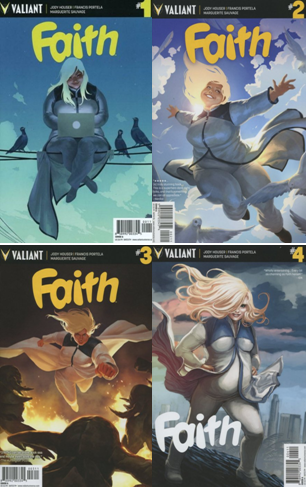
Valiant in 2016 saw wide commercial and critical success with a variety of projects. The early-2016 notable title that took some folks by surprise stars their most positive happy-to-be-a-superhero heroine, Faith Hebert, in an eponymous mini-series:


The popularity of which has spawned a regular monthly title, a slew of plush dolls and figurines, and plenty of notice from mainstream media.

2016 ends for Valiant as another high profile mini-series ends, only this limited series had enough buildup and fanfare that it's nearly impossible to consider it a sleeper. A commercial and critical success, though, it certainly is. It stars the world's first detective (or, in ancient Rome's time, called a "detectioner"), Antonius Axia:


A wildly striking and entertaining read, I find myself smitten with Valiant's prestige format. The above shots are the regular Cary Nord covers, and upon seeing all the choices, I can't imagine wanting any of the other "specials."

There is much I'd like to say about Valiant's 2016, but now I don't have the time. Bummer.

CHECK OUT THESE STORIES IF YOU HAVEN'T YET!

Monday, November 28, 2016

Stunning Sci-Fi

A book that I missed in its original run, but picked up in the collected format, is Jeff Lemire and Dustin Nguyen's Descender:


It tells the story of Tim-21, a robot who is rebooted a few decades after the robot culls and the destruction of the tentative alliance between non-robots (humans included) by planet sized robots.

It's good, and dense, and you can see where Lemire and Nguyen are heading, and the various aliens and neat, and their worlds are beautiful, and the androids are cool outlaws, but ultimately these topics come down to look.

That may be to superficial, and generally I try to avoid those snap decisions. There are plenty of good science fiction stories being created in the world today. What sets this apart?

One thing that got me was the fully painted watercolors from Dustin Nguyen.

Holy cow, it's a stunning artifact from some creative geniuses!

Published mostly monthly from Image, and collected every six months or so. Fully recommended.

Sunday, October 2, 2016

Valiant Throwback Variants

Valiant Entertainment has been using their Harvey-nominated title, Bloodshot Reborn, as a staging ground for some exciting throwback covers.

Bloodshot Reborn normally has pretty dynamic covers to go along with Jeff Lemire's great writing and Mico Suayan and Lewis LaRosa's lush artwork. Here's the main cover from issue number 1:


It was with issue 14 that the throwback covers started, when Jeff Lemire painted his own send-up of comic's first "chromium" cover, Valiant's own Bloodshot #1, though Lemire is using the figment of imagination character Bloodsquirt:


For issue #15, they parodied the look of the late '80's Marvel comics, and specifically the title "The 'Nam." This was surely inspired by the Vietnam-era version of the nanite-infested killing machine. Also, this cover is done by Darick Robertson, co-creator of Spider Jerusalem and Transmetropolitan, one of my favorite comic creations ever.


For issue #16 they dove further back into the past, back to the '60s era Marvel:


Another variant for issue #16 had Valiant again parodying their own property---or joint property, as it is---with the Deathmate cover. The original on the left is the awesome Joe Quesada "Deathmate: Prologue" comic that introduced the crossover between Valiant and Image. I remember one reviewer describing the crossover's ultimate failure in the following terms: If you mix five pounds of ice cream with five pounds of dog shit, you won't get anything edible. In the modern version, Deathmate is the name of the black and silver lady character on the right-side cover. She's a killing machine: part T-1000, part Universal Soldier:


Issue #17 is a pretty direct parody of early '90s DC Comics' Suicide Squad:


The idea of using an older property as a design influence is nothing new for Valiant Entertainment, as we see here from their Summer 2015 event, the Book of Death, where each of the four issues from the miniseries had a classic Rai #0 variant, and the one I chose here is the Livewire copy, #2.